%load_ext autoreload
%autoreload 2
%load_ext jaxtyping
%jaxtyping.typechecker beartype.beartype
%config InlineBackend.figure_format = "retina"

from typing import cast

import arviz as az
import jax.numpy as jnp
import matplotlib.dates as mdates
import matplotlib.pyplot as plt
import numpy as np
import numpyro
import numpyro.distributions as dist
import numpyro.handlers
import pandas as pd
import preliz as pz
from jax import random
from numpyro.contrib.hsgp.approximation import hsgp_matern
from numpyro.infer import SVI, Predictive, Trace_ELBO, init_to_feasible
from numpyro.infer.autoguide import AutoNormal
from numpyro.optim import Adam

from numpyro_forecast import (
    Horizon,
    draw_posterior,
    evaluate_forecast,
    forecast,
    predict,
    predict_in_sample,
)
from numpyro_forecast.datasets import load_victoria_electricity
from numpyro_forecast.features import periodic_repeat
from numpyro_forecast.typing import Array

az.style.use("arviz-darkgrid")
plt.rcParams["figure.figsize"] = [12, 7]
plt.rcParams["figure.dpi"] = 100
plt.rcParams["figure.facecolor"] = "white"

numpyro.set_host_device_count(n=4)

rng_key = random.PRNGKey(seed=42)Electricity demand forecasting: prior calibration
Calibrate the priors of the electricity demand model against domain knowledge about the temperature effect, iterating with prior predictive checks before refitting.
Electricity demand forecasting: prior calibration with numpyro_forecast
This notebook ports the blog post Electricity Demand Forecast: Prior Calibration to the numpyro_forecast package. It is a direct continuation of the electricity demand forecasting example: we keep the exact same model (a varying-coefficient temperature effect via a Hilbert Space Gaussian Process, plus hour-of-day and day-of-week seasonality and a Student-t likelihood) and add a single new ingredient, a calibration likelihood.
The idea of calibration is to inject domain knowledge into the model as an extra likelihood term. Suppose that, from experimental or observational data, we believe the effect of temperature on demand stabilizes at a known value once it gets hot enough, say around 0.13 for temperatures above 32 °C. Instead of only encoding this through priors, we observe the latent temperature effect directly in that regime. The obs= argument turns a sample statement into a likelihood, so the posterior now has to explain both the demand data and this belief about the temperature effect at extreme values.
Throughout the package, time lives at axis -2 and the observation dimension at -1, and the forecast horizon is inferred from the covariates being longer than the data.
Prepare notebook
Load data
We load the data through the package helper load_victoria_electricity, which returns the demand series (shape (time, 1), the package convention) and the aligned temperature series. We reference the original comment from the TensorFlow Probability example:
“Victoria electricity demand dataset, as presented at https://otexts.com/fpp2/scatterplots.html and downloaded from https://github.com/robjhyndman/fpp2-package/blob/master/data/elecdaily.rda . This series contains the first eight weeks (starting Jan 1). The original dataset was half-hourly data; here we’ve downsampled to hourly data by taking every other timestep.”
demand, temperature = load_victoria_electricity()
duration = demand.shape[0]

demand_values = np.asarray(demand[:, 0])
temperature_values = np.asarray(temperature)

demand_dates = np.array("2014-01-01", dtype="datetime64[h]") + np.arange(duration)
demand_loc = mdates.WeekdayLocator(byweekday=mdates.WE)
demand_fmt = mdates.DateFormatter("%a %b %d")

print("demand shape:", demand.shape)
print("temperature shape:", temperature.shape)
demand shape: (1344, 1)
temperature shape: (1344,)Let’s visualize the data:
fig, ax = plt.subplots(nrows=2, ncols=1, sharex=True, sharey=False, layout="constrained")
ax[0].plot(demand_dates, demand_values, c="C0")
ax[0].set(
    title="Electricity Demand in Victoria, Australia (2014)",
    ylabel="Hourly Demand (GW)",
)
ax[1].plot(demand_dates, temperature_values, c="C1")
ax[1].set(title="Temperature", ylabel="Temperature (°C)")
ax[1].xaxis.set_major_locator(demand_loc)
ax[1].xaxis.set_major_formatter(demand_fmt)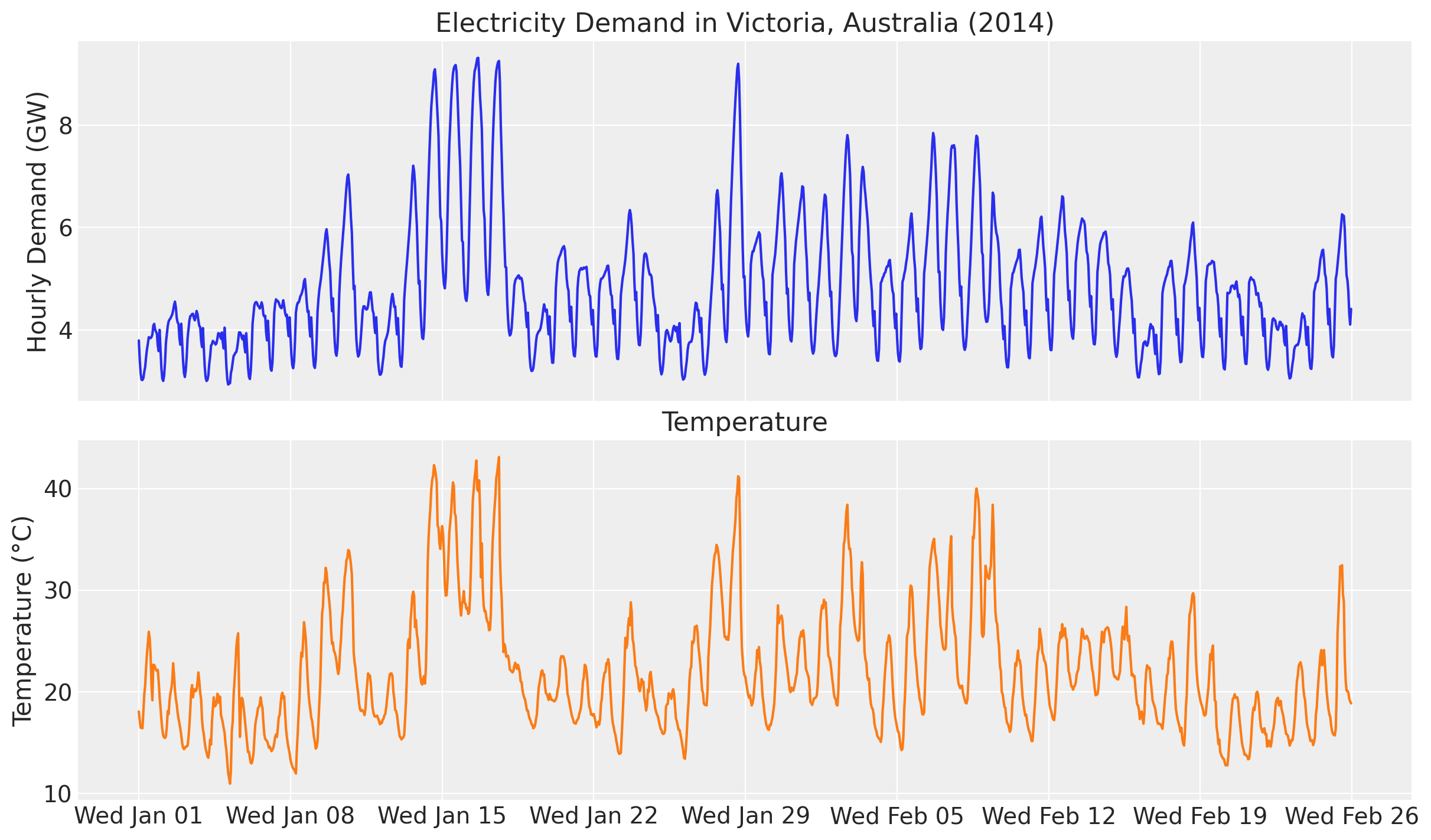
As in the baseline example, there is a clear positive correlation between temperature and demand, and the relationship is non-linear. The scatter plot below motivates the calibration: at the high end of the temperature range the air-conditioning effect dominates and the per-degree effect on demand settles around a stable value. This is exactly the regime where we will anchor the model with domain knowledge.
fig, ax = plt.subplots()
ax.scatter(temperature_values, demand_values)
ax.axvline(x=32.0, color="C3", linestyle="--", label="32 °C threshold")
ax.legend()
ax.set(title="Demand vs Temperature", xlabel="Temperature (°C)", ylabel="Demand (GW)");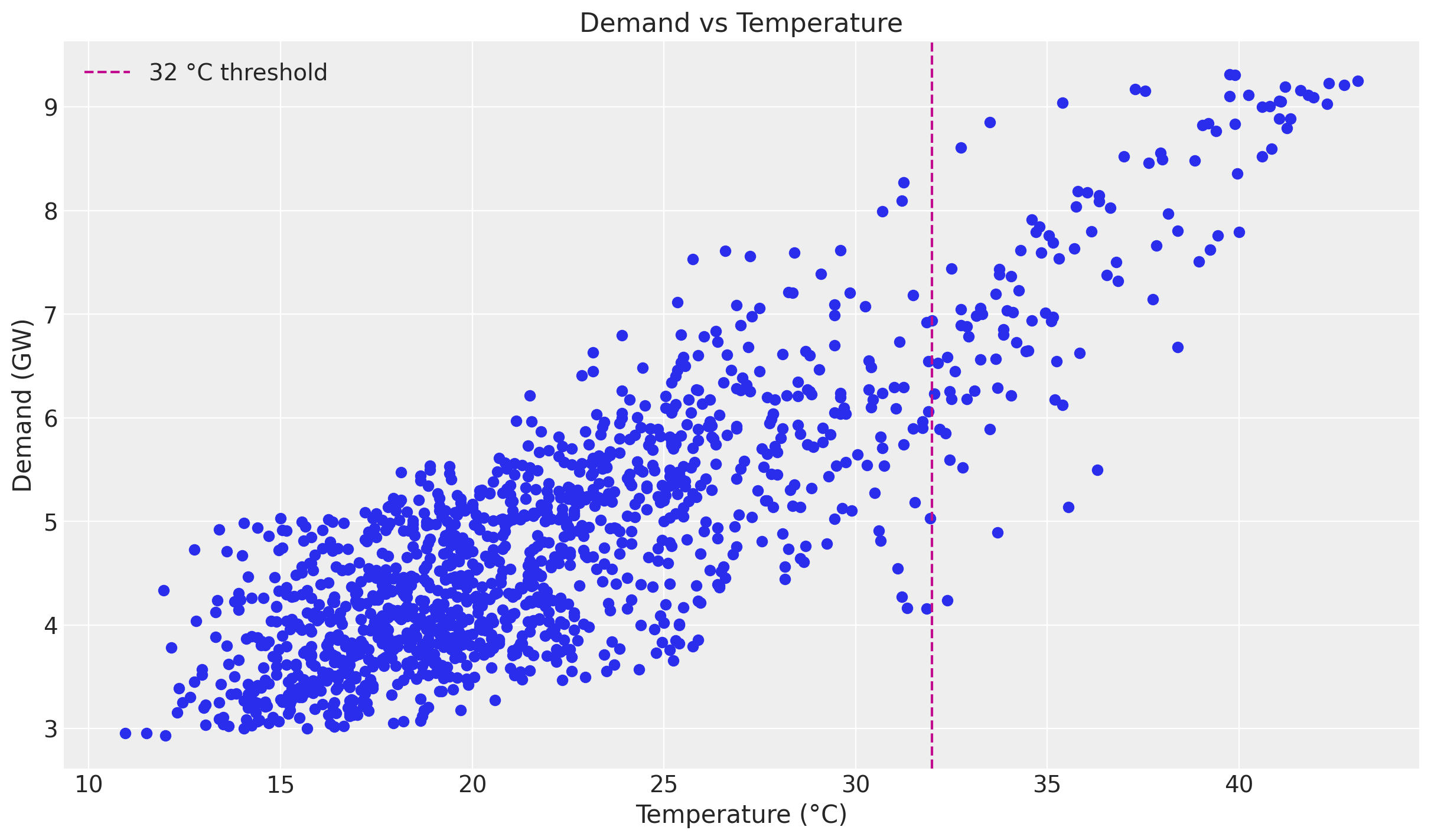
Training and test data
We split the data as in the original example, holding out the last two weeks. We build the exogenous inputs the model needs and pack them into a single covariates array with time at axis -2: the temperature and a day_of_week index. The forecast horizon is inferred later from covariates being longer than the training data.
num_forecast_steps = 24 * 7 * 2  # two weeks
t_train = duration - num_forecast_steps

data_train = demand[:t_train]
data_test = demand[t_train:]

dates_train = demand_dates[:t_train]
dates_test = demand_dates[t_train:]

day_of_week = np.array([d.weekday() for d in demand_dates.astype("datetime64[D]").astype(object)])

covariates = jnp.stack([temperature, jnp.asarray(day_of_week, dtype=jnp.float32)], axis=-1)
covariates_train = covariates[:t_train]

print("data_train shape:", data_train.shape)
print("data_test shape:", data_test.shape)
print("covariates shape:", covariates.shape)
data_train shape: (1008, 1)
data_test shape: (336, 1)
covariates shape: (1344, 2)Model specification
The model is the same plain NumPyro model function as in the baseline example, built with the numpyro_forecast predict building block:
- A linear-in-features model predicts demand from temperature and two seasonal effects, hour of day and day of week, both modeled with Zero-Sum Normal distributions.
- A Matérn 5/2 kernel models the temperature effect on demand through the Hilbert Space Gaussian Process (HSGP) approximation from NumPyro.
- The noise scale varies with the temperature, and a Student-t distribution models the residual error.
The only addition is the calibration likelihood. We assume that, from domain knowledge, the effect of temperature on demand for temperatures over 32 °C is stable at around 0.13. We encode this as an extra observation on the latent Gaussian Process coefficient beta_temperature.
The calibration likelihood: index vs mask
In the standalone NumPyro model from the blog post, the calibration term is written by indexing the latent effect at the high-temperature timesteps:
temperature_prior_idx = jnp.where(temperature_training_data > 32.0)[0]
numpyro.sample(
    "temperature_prior",
    dist.Normal(loc=0.13, scale=0.01),
    obs=beta_temperature[temperature_prior_idx],
)
In numpyro_forecast a single model handles both training and forecasting, so covariates (and therefore beta_temperature) change length between the two regimes and a fixed integer index does not translate cleanly. The idiomatic, jit-safe equivalent is a masked likelihood: we build a boolean mask from the temperature covariate and apply it with numpyro.handlers.mask.
These two formulations are mathematically identical at training time. numpyro.handlers.mask multiplies each element’s log_prob by the 0/1 mask, so the calibration factor is the sum of Normal(0.13, 0.01).log_prob(beta_temperature[t]) over exactly the timesteps where temperature[t] > 32 °C, the same terms the index version sums. The mask form has static shapes, works for both the in-sample fit and the forecast horizon, and during forecasting is harmless because beta_temperature is deterministic given the posterior and the forecast only reads the forecast site.
GP prior parameters
As in the baseline example, we set the Gaussian Process amplitude and length-scale priors with preliz by assuming both come from an Inverse-Gamma distribution and specifying the support.
# For the amplitude, we set the values inspired on the range of the demand / temperature
# ratio.
_ = pz.maxent(pz.InverseGamma(), lower=0.1, upper=0.5)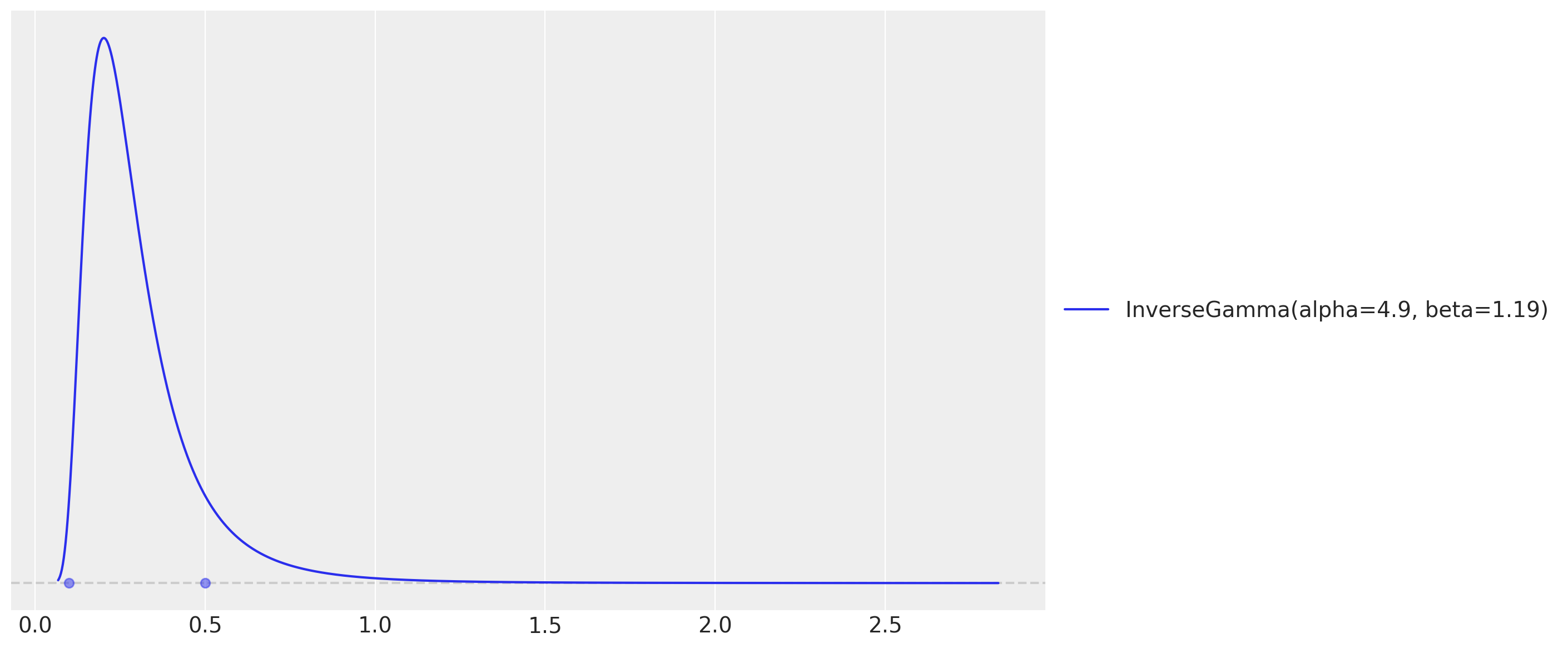
# As we want to use the GP to model the temperature effect, we need to set the length
# scale parameter. We expect these effects to be seen at the order of units or tens of
# units, so we expect the length scale to be between 3 and 10.
_ = pz.maxent(pz.InverseGamma(), lower=3, upper=10)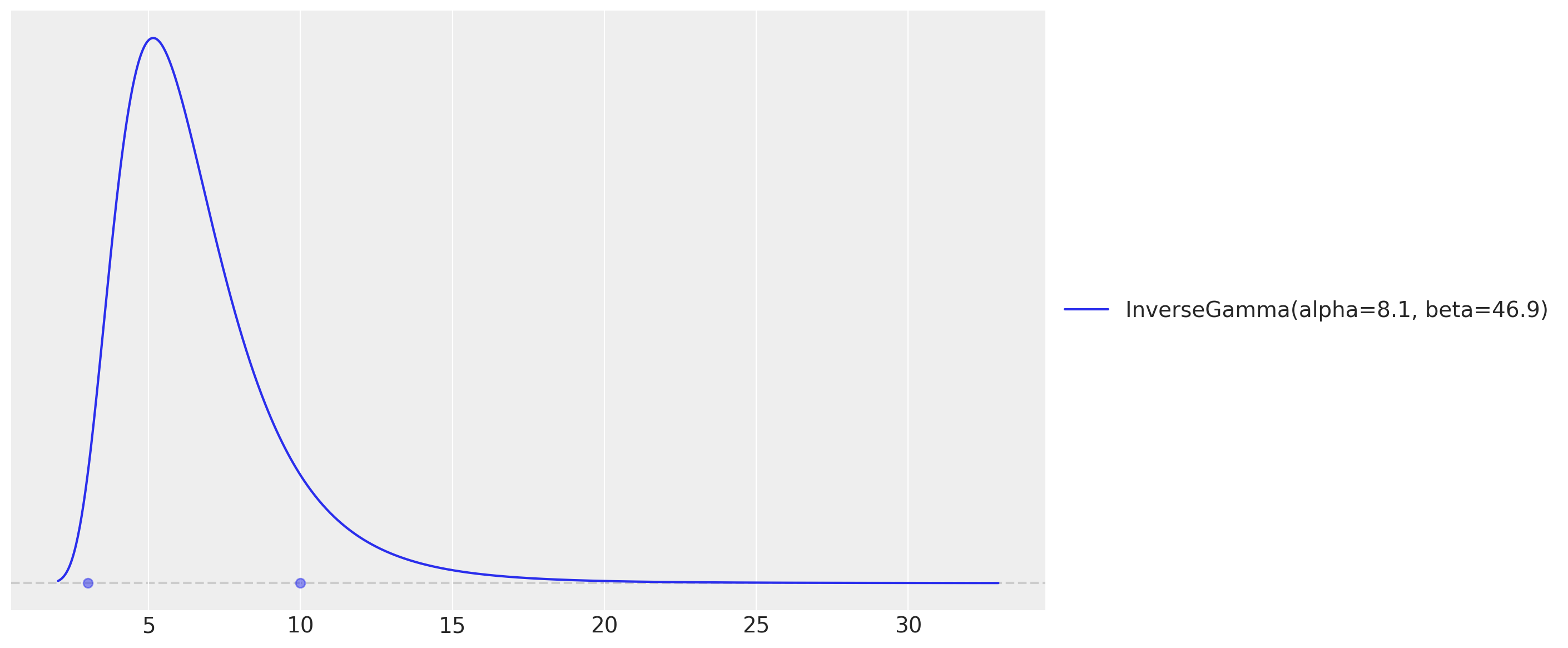
These two maxent calls return the Inverse-Gamma parameters we plug into the model below. The model is identical to the baseline, with the masked calibration likelihood added just after the beta_temperature deterministic site. The HSGP settings and the three calibration numbers (threshold, target mean, target scale) are module constants, so the plots below can read them back.
ELL = 55.0  # HSGP boundary factor
M = 25  # number of HSGP basis functions
TEMP_THRESHOLD = 32.0  # temperature (°C) above which the calibration likelihood applies
PRIOR_MEAN = 0.13  # domain-knowledge mean of the temperature effect above the threshold
PRIOR_SCALE = 0.01  # scale (uncertainty) of the calibration likelihood


def calibrated_electricity_model(covariates: Array, data: Array | None = None) -> None:
    """HSGP temperature effect with hour/day seasonality and a calibration likelihood.

    Same model as ``electricity_model`` in the baseline example, plus a masked
    Normal likelihood on the latent temperature effect that anchors it to a
    domain-knowledge value in the high-temperature regime.
    """
    h = Horizon.from_data(covariates, data)
    duration = covariates.shape[-2]
    temperature = covariates[..., 0]
    day_of_week = covariates[..., 1].astype("int32")

    # Intercept.
    intercept = numpyro.sample("intercept", dist.Normal(loc=0.0, scale=2.0))

    # GP parameters (amplitude and length-scale priors are the preliz maxent fits).
    alpha = numpyro.sample("alpha", dist.InverseGamma(concentration=6.66, rate=1.57))
    length_scale = numpyro.sample("length_scale", dist.InverseGamma(concentration=11.0, rate=62.2))
    scale_factor = numpyro.sample("scale", dist.HalfNormal(scale=0.5))
    # Degrees of freedom for the Student-t likelihood.
    nu = numpyro.sample("nu", dist.Gamma(concentration=8.0, rate=3.0))

    # Non-linear temperature effect as a Matérn 5/2 HSGP. ``hsgp_matern`` is
    # annotated for float hyperparameters, so we cast the sampled scalars.
    beta_temperature = hsgp_matern(
        x=temperature,
        nu=5 / 2,
        alpha=cast("float", alpha),
        length=cast("float", length_scale),
        ell=ELL,
        m=M,
    )
    numpyro.deterministic("beta_temperature", beta_temperature)

    # Calibration likelihood: anchor the latent temperature effect to the
    # domain-knowledge value where temperature exceeds the threshold. The mask
    # keeps only the high-temperature contributions, matching the blog's
    # ``beta_temperature[temperature_prior_idx]`` indexing.
    high_temp_mask = temperature > TEMP_THRESHOLD
    with numpyro.handlers.mask(mask=high_temp_mask):
        numpyro.sample(
            "temperature_prior",
            dist.Normal(loc=PRIOR_MEAN, scale=PRIOR_SCALE),
            obs=beta_temperature,
        )

    # Hour-of-day effect, tiled over the horizon with periodic_repeat.
    scale_hour_of_day = numpyro.sample("scale_hour_of_day", dist.HalfNormal(scale=0.5))
    hour_of_day_effect = numpyro.sample(
        "hour_of_day_effect",
        dist.ZeroSumNormal(scale=scale_hour_of_day, event_shape=(24,)),
    )
    hour_of_day_effect = periodic_repeat(hour_of_day_effect, duration, axis=-1)

    # Day-of-week effect, indexed by the calendar covariate.
    scale_day_of_week = numpyro.sample("scale_day_of_week", dist.HalfNormal(scale=0.5))
    day_of_week_effect = numpyro.sample(
        "day_of_week_effect",
        dist.ZeroSumNormal(scale=scale_day_of_week, event_shape=(7,)),
    )

    # Expected demand and a temperature-dependent Student-t noise scale.
    mu = (
        beta_temperature * temperature
        + intercept
        + hour_of_day_effect
        + jnp.take(day_of_week_effect, day_of_week)
    )
    scale = scale_factor * jnp.sqrt(temperature)

    predict(h, dist.StudentT(df=nu, loc=0.0, scale=scale[..., None]), mu[..., None])
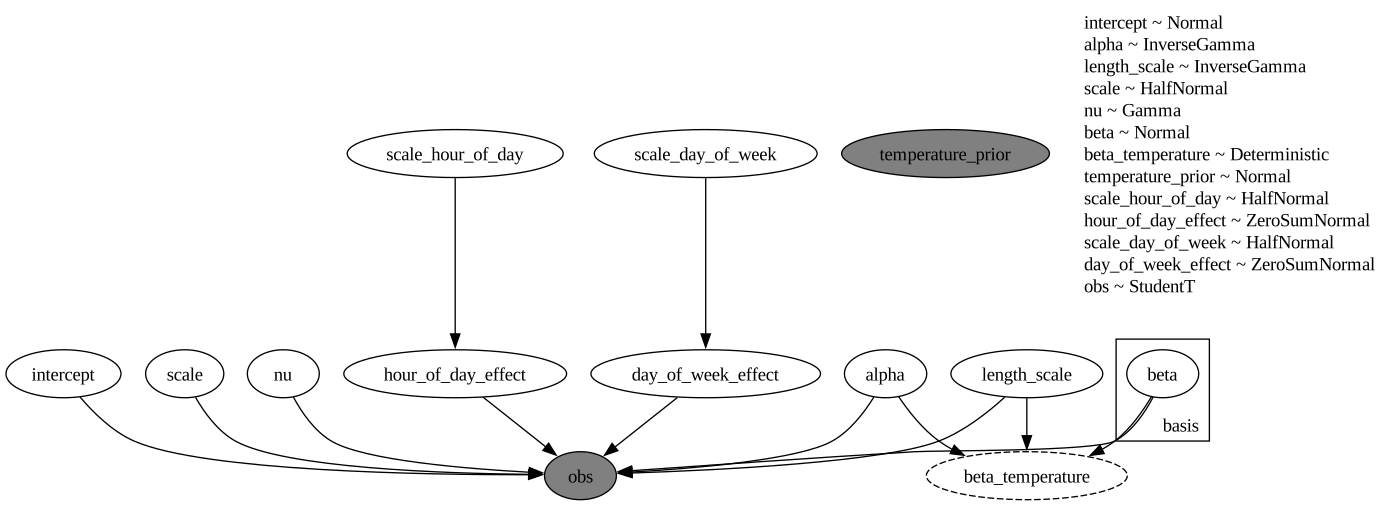
The model function is a plain NumPyro model callable (covariates, data=None), so we can render its structure directly. The rendered graph shows the new observed temperature_prior node next to the demand obs node.
numpyro.render_model(
    calibrated_electricity_model,
    model_args=(covariates_train, data_train),
    render_distributions=True,
    render_params=True,
)
Prior predictive checks
Before we fit the model, let’s visualize the prior predictive distribution. The model function is a plain NumPyro model, so we hand it to Predictive directly. We draw the bands with ArviZ’s plot_lm, which computes the 50\% and 94\% HDI internally; since the time axis is a datetime64 array we pass it as matplotlib date numbers (mdates.date2num) and restore the date formatter on the returned axis.
prior_predictive = Predictive(
    calibrated_electricity_model, num_samples=2_000, return_sites=["obs"]
)
rng_key, rng_subkey = random.split(rng_key)
prior_obs = prior_predictive(rng_subkey, covariates_train)["obs"][..., 0]

xnum_train = mdates.date2num(dates_train)

idata_prior = az.from_dict(
    {
        "prior_predictive": {"obs": np.asarray(prior_obs)[None]},
        "observed_data": {"obs": np.asarray(data_train[:, 0])},
        "constant_data": {"date": xnum_train},
    },
    coords={"time": xnum_train},
    dims={"obs": ["time"], "date": ["time"]},
)
pc = az.plot_lm(
    idata_prior,
    y="obs",
    x="date",
    group="prior_predictive",
    ci_kind="hdi",
    ci_prob=(0.5, 0.94),
    smooth=False,
    visuals={"ci_band": {"color": "C0"}, "observed_scatter": False, "pe_line": False},
    figure_kwargs={"figsize": (12, 7)},
)
ax = pc.viz["figure"].item().axes[0]
bands = pc.viz["ci_band"]["date"]
band_94, band_50 = bands.sel(prob=0.94).item(), bands.sel(prob=0.5).item()
band_94.set_label(r"$94\%$ HDI")
band_50.set_label(r"$50\%$ HDI")
(train_line,) = ax.plot(
    xnum_train, np.asarray(data_train[:, 0]), c="black", lw=1, label="Training Data"
)
ax.xaxis.set_major_locator(demand_loc)
ax.xaxis.set_major_formatter(demand_fmt)
ax.legend(handles=[band_94, band_50, train_line])
ax.set(title="Prior Predictive Checks", ylabel="Demand (GW)", xlabel="Time");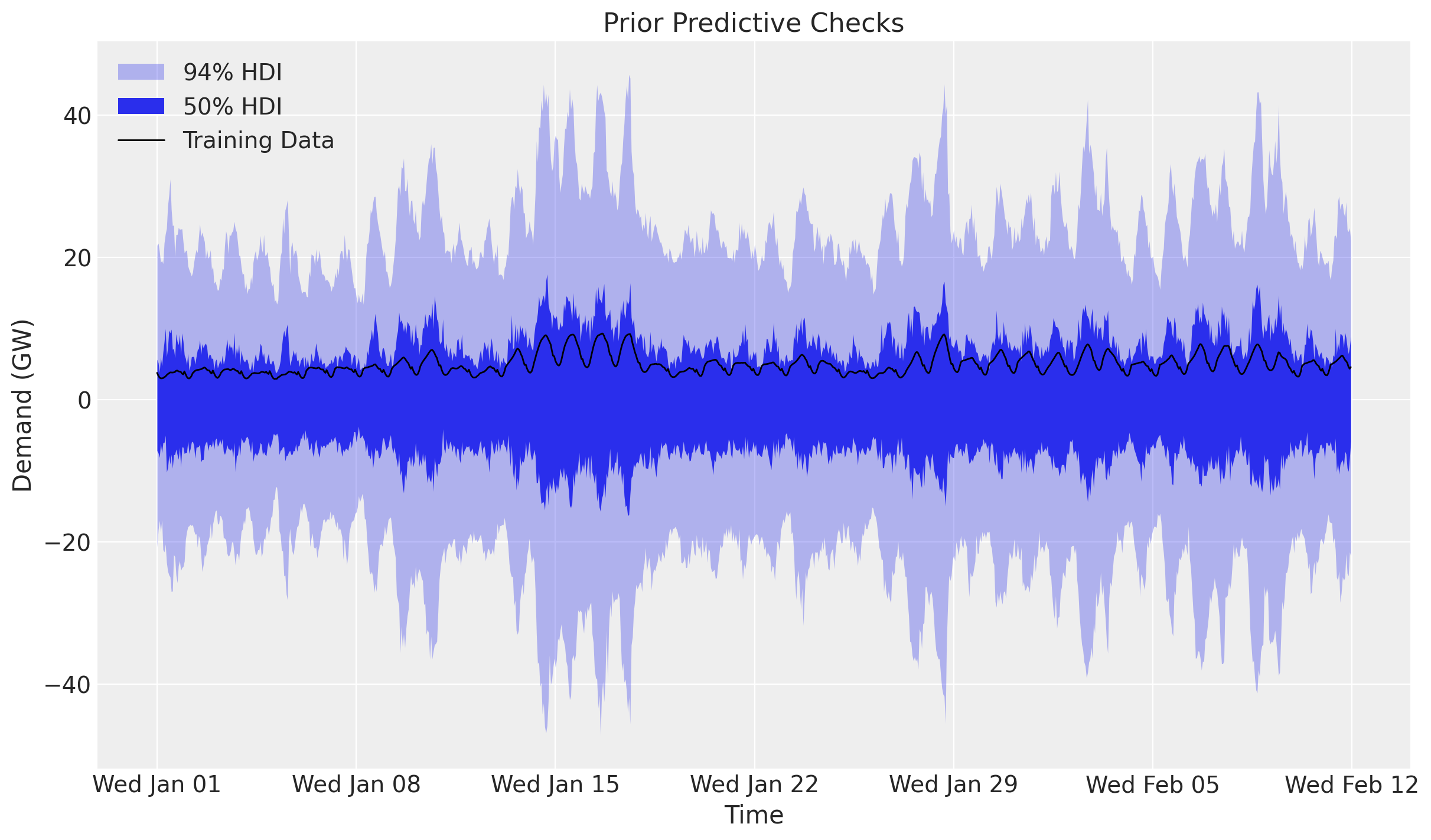
Inference with SVI
We fit the model with plain NumPyro stochastic variational inference: an AutoNormal guide, Adam, and SVI.run, which returns the fitted params and the ELBO losses. As in the baseline example, the posterior is multimodal: the multiplicative beta_temperature * temperature term trades off against the overall level, so a guide initialized at random can settle on a monotonic temperature effect. We initialize the guide at a feasible point (init_to_feasible), which reliably recovers the heating-and-cooling (U-shaped) effect. We keep the same optimizer (Adam(step_size=0.005)) and number of steps (50_000) as the blog post.
rng_key, rng_subkey = random.split(rng_key)
guide = AutoNormal(calibrated_electricity_model, init_loc_fn=init_to_feasible)
svi = SVI(calibrated_electricity_model, guide, Adam(step_size=0.005), Trace_ELBO())
svi_result = svi.run(rng_subkey, 50_000, covariates_train, data_train, progress_bar=False)

fig, ax = plt.subplots(figsize=(9, 6))
ax.plot(svi_result.losses)
ax.set_yscale("log")
ax.set_title("ELBO loss", fontsize=18, fontweight="bold");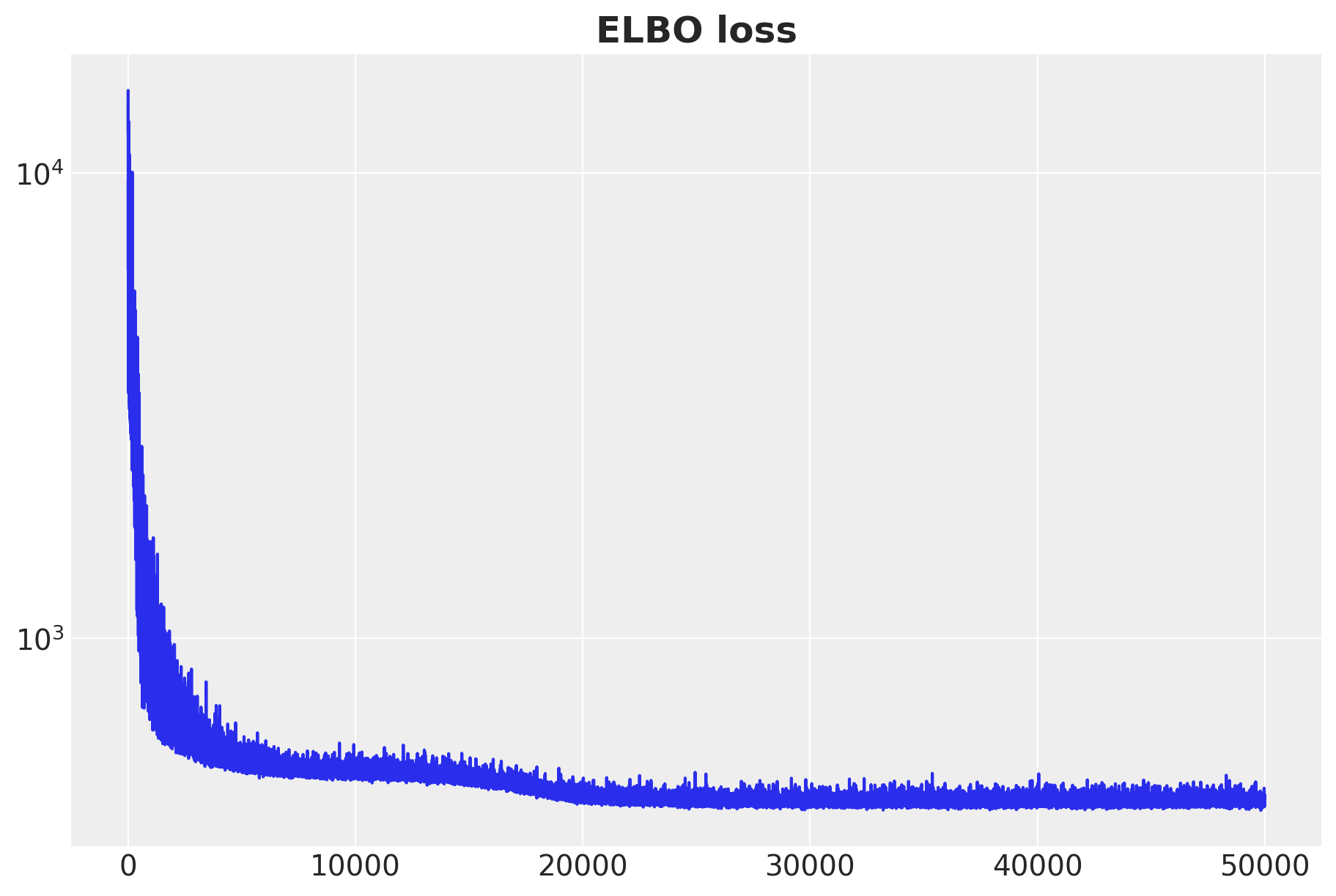
The ELBO loss is decreasing as expected.
Posterior predictive checks
We now draw posterior latents from the fitted guide with draw_posterior, push them through the model over the training window with predict_in_sample, and forecast the held-out two weeks with forecast and the full-horizon covariates. draw_posterior returns the deterministic sites along with the latents, so the posterior dictionary already carries beta_temperature for the calibrated temperature-effect plot later.
num_posterior_samples = 5_000

rng_key, key_post, key_pp, key_fc = random.split(rng_key, 4)
posterior = draw_posterior(key_post, guide, svi_result.params, num_posterior_samples)
train_pp = predict_in_sample(key_pp, calibrated_electricity_model, posterior, covariates_train)
forecast_draws = forecast(key_fc, calibrated_electricity_model, posterior, data_train, covariates)
Forecast evaluation
We score the train and test forecasts with evaluate_forecast, which reports several metrics at once: CRPS (the Continuous Ranked Probability Score), mean absolute error, root mean squared error, and the empirical coverage of the central 90\% prediction interval. The scores should land close to the uncalibrated baseline: the calibration term refines the temperature effect in the high-temperature regime without hurting overall forecast accuracy.
train_metrics = evaluate_forecast(train_pp, data_train)
test_metrics = evaluate_forecast(forecast_draws, data_test)

metrics_table = pd.DataFrame({"train": train_metrics, "test": test_metrics})
metrics_table| train | test | |
|---|---|---|
| mae | 0.389393 | 0.263976 |
| rmse | 0.520497 | 0.334185 |
| crps | 0.280632 | 0.192164 |
| coverage | 0.917659 | 0.994048 |
train_obs = train_pp[..., 0]
forecast_obs = forecast_draws[..., 0]

xnum_test = mdates.date2num(dates_test)

idata_train = az.from_dict(
    {
        "posterior_predictive": {"obs": np.asarray(train_obs)[None]},
        "observed_data": {"obs": np.asarray(data_train[:, 0])},
        "constant_data": {"date": xnum_train},
    },
    coords={"time": xnum_train},
    dims={"obs": ["time"], "date": ["time"]},
)
idata_test = az.from_dict(
    {
        "posterior_predictive": {"obs": np.asarray(forecast_obs)[None]},
        "observed_data": {"obs": np.asarray(data_test[:, 0])},
        "constant_data": {"date": xnum_test},
    },
    coords={"time": xnum_test},
    dims={"obs": ["time"], "date": ["time"]},
)

pc = az.plot_lm(
    idata_train,
    y="obs",
    x="date",
    ci_kind="hdi",
    ci_prob=(0.5, 0.94),
    smooth=False,
    visuals={"ci_band": {"color": "C0"}, "observed_scatter": False, "pe_line": False},
    figure_kwargs={"figsize": (12, 7)},
)
train_bands = pc.viz["ci_band"]["date"]
band_train_94 = train_bands.sel(prob=0.94).item()
band_train_50 = train_bands.sel(prob=0.5).item()
az.plot_lm(
    idata_test,
    y="obs",
    x="date",
    plot_collection=pc,
    ci_kind="hdi",
    ci_prob=(0.5, 0.94),
    smooth=False,
    visuals={"ci_band": {"color": "C1"}, "observed_scatter": False, "pe_line": False},
)
test_bands = pc.viz["ci_band"]["date"]
band_test_94 = test_bands.sel(prob=0.94).item()
band_test_50 = test_bands.sel(prob=0.5).item()
ax = pc.viz["figure"].item().axes[0]
band_train_94.set_label(r"in-sample $94\%$ HDI")
band_train_50.set_label(r"in-sample $50\%$ HDI")
band_test_94.set_label(r"forecast $94\%$ HDI")
band_test_50.set_label(r"forecast $50\%$ HDI")
obs_dates = mdates.date2num(np.concatenate([dates_train, dates_test]))
obs_values = np.concatenate([np.asarray(data_train[:, 0]), np.asarray(data_test[:, 0])])
(obs_line,) = ax.plot(obs_dates, obs_values, c="black", lw=1, label="Observed Data")
split_line = ax.axvline(x=xnum_train[-1], color="gray", linestyle="--", label="Train/Test Split")
ax.xaxis.set_major_locator(demand_loc)
ax.xaxis.set_major_formatter(demand_fmt)
ax.legend(
    handles=[band_train_94, band_train_50, band_test_94, band_test_50, obs_line, split_line],
    loc="upper center",
    bbox_to_anchor=(0.5, -0.1),
    ncol=3,
)
ax.set(
    title=f"Train CRPS: {train_metrics['crps']:.3f}, Test CRPS: {test_metrics['crps']:.3f}",
    ylabel="Demand (GW)",
    xlabel="Time",
)
fig = pc.viz["figure"].item()
fig.suptitle("Posterior Predictive Checks", fontsize=18, fontweight="bold");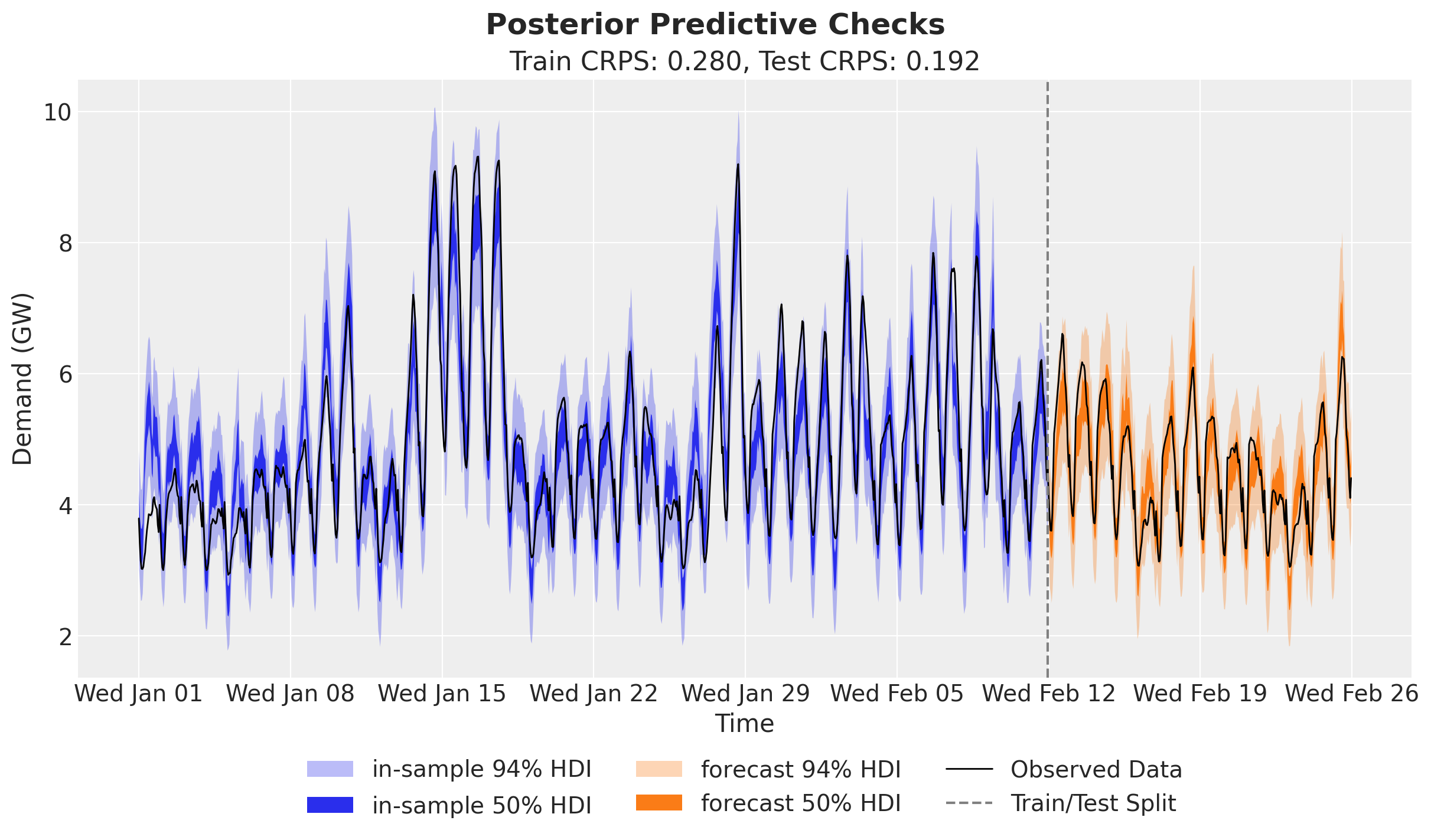
Temperature effect on demand
This is where the calibration shows up. We plot the posterior distribution of the Gaussian Process component beta_temperature against temperature, sorting by temperature so the HDI band reads cleanly. The vertical line marks the 32 °C threshold and the shaded band shows the calibration target of 0.13 ± 0.01 for temperatures above it.
temperature_train = np.asarray(temperature[:t_train])
order = np.argsort(temperature_train)
beta_temperature = posterior["beta_temperature"]

prior_mean = PRIOR_MEAN
prior_scale = PRIOR_SCALE
threshold = TEMP_THRESHOLD

idata_beta = az.from_dict(
    {
        "posterior_predictive": {"obs": np.asarray(beta_temperature[:, order])[None]},
        "observed_data": {"obs": np.zeros_like(temperature_train[order])},
        "constant_data": {"temperature": temperature_train[order]},
    },
    dims={"obs": ["obs_dim"], "temperature": ["obs_dim"]},
)
pc = az.plot_lm(
    idata_beta,
    y="obs",
    x="temperature",
    ci_kind="hdi",
    ci_prob=(0.5, 0.94),
    visuals={"ci_band": {"color": "C1"}, "observed_scatter": False, "pe_line": False},
    figure_kwargs={"figsize": (12, 7)},
)
ax = pc.viz["figure"].item().axes[0]
bands = pc.viz["ci_band"]["temperature"]
band_94, band_50 = bands.sel(prob=0.94).item(), bands.sel(prob=0.5).item()
band_94.set_label(r"$94\%$ HDI")
band_50.set_label(r"$50\%$ HDI")
threshold_line = ax.axvline(
    x=threshold, color="C3", linestyle="--", label=f"{threshold:.0f} °C threshold"
)
target_line = ax.axhline(
    y=prior_mean, color="C0", linestyle="--", label=f"Calibration target {prior_mean}"
)
high_temp = (temperature_train[order] > threshold).tolist()
target_band = ax.fill_between(
    temperature_train[order],
    prior_mean - prior_scale,
    prior_mean + prior_scale,
    where=high_temp,
    color="C0",
    alpha=0.2,
    label="Calibration target ± 1 sd",
)
ax.legend(handles=[band_94, band_50, threshold_line, target_line, target_band])
ax.set(
    title="Calibrated Temperature Effect on Demand",
    xlabel="Temperature (°C)",
    ylabel="Effect on Demand",
);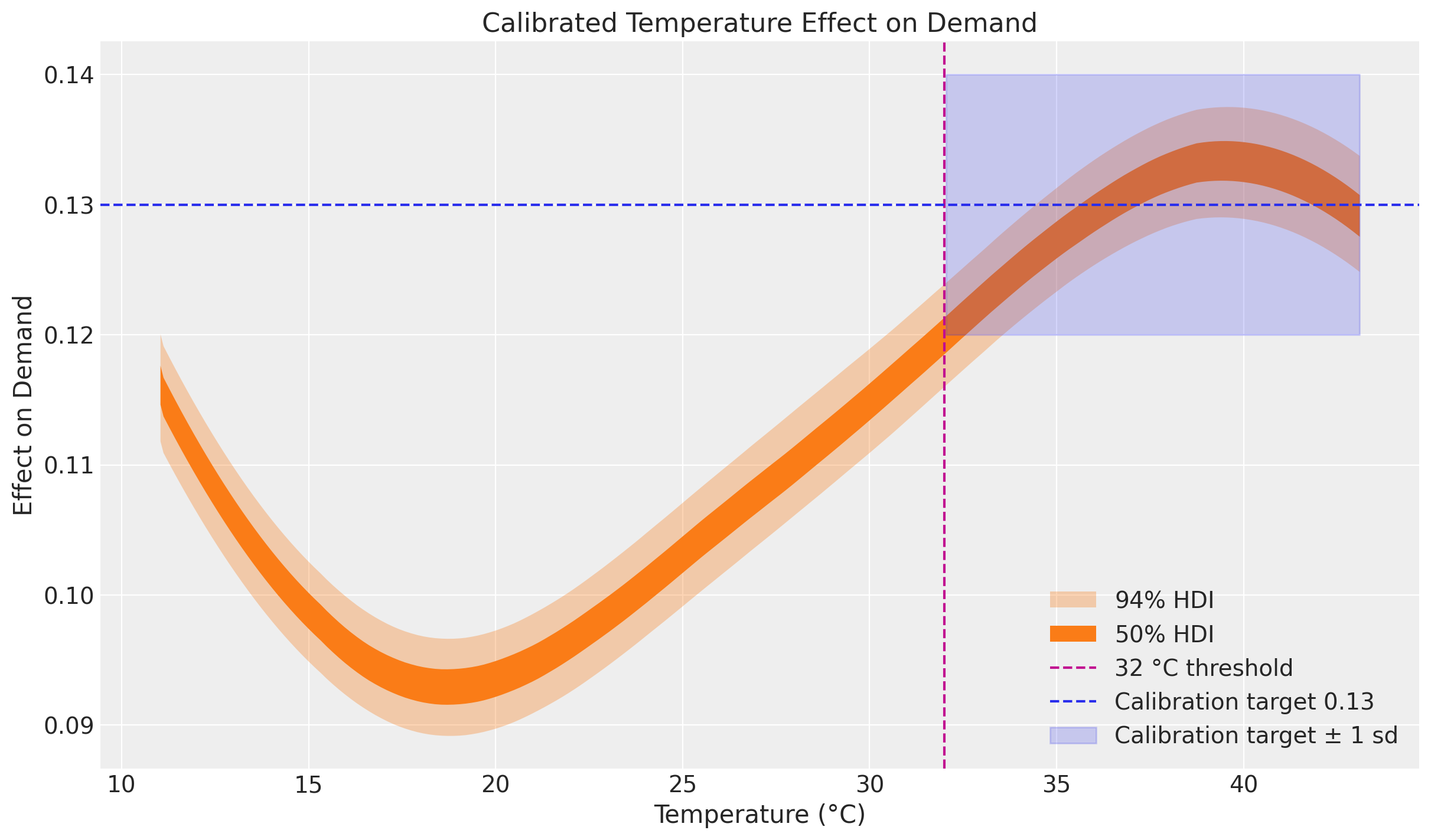
The overall shape of the curve resembles the one in the baseline uncalibrated electricity demand example: the temperature effect increases at both extremes of the common temperature range, reflecting the heating and cooling effects noted by Hyndman and Athanasopoulos. The difference is at the high end: the calibration likelihood pulls the estimate for temperatures over 32 °C toward the expected value of 0.13, with somewhat tighter credible bands than in the uncalibrated model.
This opens up nice opportunities to calibrate forecasting models with domain knowledge, possibly extracted from experimental or observational data. The mechanism is general: any latent quantity in a model function can be anchored with an extra observed numpyro.sample site, optionally masked to the region where the domain knowledge applies.
References
- Orduz, J. Electricity Demand Forecast: Prior Calibration.
- Orduz, J. Electricity Demand Forecast: Dynamic Time-Series Model (the uncalibrated baseline this notebook extends).
- Continuous Ranked Probability Score (Wikipedia).